
If your Air Canada flight was delayed by three hours or more, you’re entitled to compensation of at least 400 CAD under Canadian Air Passenger Protection Regulations (APPR). The amount you can claim depends on how late you arrived at your final destination, not just when the delay started, and it covers flights operated by Air Canada, Air Canada Rouge, and Air Canada Express.
I learned about these passenger rights the hard way after sitting in the Toronto Pearson departure lounge for five hours last summer, watching my connection to Vancouver slip away. Once I finally landed (seven hours later than planned), I felt frustrated and exhausted. But then a fellow passenger mentioned she’d already filed for compensation using Air Canada’s online tool. That conversation turned my terrible travel day into a 400-dollar lesson about knowing your rights.
The good news? Air Canada now offers a Self-Serve Eligibility Tool that walks you through whether your specific flight disruption qualifies for compensation and expense reimbursement. You don’t need to be a lawyer or spend hours on hold to figure out if you’re owed money. The system is designed to be straightforward, though understanding what qualifies (and what doesn’t) makes all the difference.
Here’s what you need to know about claiming what you’re owed, how much compensation you can expect for different delay lengths, and the specific situations where airlines are off the hook. Because missing out on that Vancouver sunset was bad enough without leaving hundreds of dollars on the table.
What Are Your Rights Under Canadian Air Passenger Protection Regulations?
Canada’s Air Passenger Protection Regulations exist for one simple reason: to give you real power when airlines mess up your travel plans. These rules, which came into force a few years back, mean Air Canada can’t just leave you stranded at the gate with a shrug and a voucher anymore. You’ve got concrete rights now, and they come with actual dollar amounts attached.
The APPR framework covers all flights operated by Air Canada, Air Canada Rouge, and Air Canada Express. That’s important because sometimes you book through Air Canada but end up on a smaller regional partner flight. As long as Air Canada’s name is on that booking, you’re protected.
So what counts as a disruption? The regulations cover three main scenarios: delays, cancellations, and denied boarding. If your flight arrives at your final destination more than three hours late, gets cancelled entirely, or you get bumped because they overbooked, you’re potentially entitled to compensation. The key phrase here is “final destination” because that’s how they calculate whether you qualify and how much you’re owed.
Here’s what makes these rules genuinely useful: they put the burden on Air Canada to prove why a disruption happened, not on you to fight for basic fairness. The airline has to show that a delay or cancellation was either within their control or outside it. If it was within their control and not related to safety, you’re getting paid.
The regulations also require Air Canada to provide you with clear information about your rights at the airport. You should see notices explaining what you’re entitled to, though I’ll be honest, those posted sheets can be pretty dry reading when you’re already frustrated about missing your connection to Whistler.
How Much Money Can You Actually Get?
Here’s the real talk about compensation amounts: the Canadian Air Passenger Protection Regulations don’t just give you a vague “maybe some money” promise. They spell out exactly what you’re owed in Canadian dollars, and honestly, the numbers can be pretty substantial.
The key thing to understand is that compensation is calculated based on when you actually arrive at your final destination, not when your delayed flight eventually takes off. So if you were supposed to land at 2 PM but you don’t touch down until 7 PM, that five-hour delay puts you in the compensation zone.
Here’s how the money breaks down:
| Delay at Final Destination | Compensation Amount | What That Could Cover |
|---|---|---|
| 3 to 6 hours | $400 CAD | Two nights at a mid-range hotel in most Canadian cities |
| 6 to 9 hours | $700 CAD | A week’s worth of meals for two, or a decent rental car for several days |
| 9+ hours | $1,000 CAD | Return flights within Canada, or a solid chunk of your next trip’s budget |
I find it helpful to think about these amounts in terms of actual travel experiences. That $400 for a three-hour delay isn’t just abstract compensation. It’s real money that could cover accommodations, meals, or activities you had to miss because of the disruption. And if you’re someone who already follows money-saving tips when traveling, getting this compensation back can genuinely offset the financial hit of a delay.
The calculation is straightforward. Air Canada looks at your original scheduled arrival time and compares it to when you actually arrived. The difference determines which compensation tier applies. So if your connecting flight was delayed and you arrived eight hours late at your final destination, you’re entitled to $700, even if no single flight segment was delayed that long.
What makes this even better is that these are minimum amounts set by regulation. Air Canada has to pay them if the delay was within their control, and the money is yours regardless of what the delay cost you personally.
When Air Canada Doesn’t Have to Pay (And Why)
Here’s the hard truth: not every delay gets you compensation, even if it completely messes up your plans. I learned this the frustrating way when a snowstorm grounded my flight to Whitehorse one February. Air Canada didn’t owe me a cent, despite the seven-hour delay, because the weather was genuinely beyond their control.
Under the Canadian Air Passenger Protection Regulations, Air Canada doesn’t have to compensate you when the disruption is caused by something outside their control. This includes severe weather conditions, natural disasters, security threats, airport operational issues not caused by the airline, or medical emergencies requiring an unscheduled landing. They also don’t pay when the delay is for safety reasons, like discovering a mechanical issue that needs immediate attention. I know it stings to hear this when you’re stuck at the airport, but honestly, I’d rather they fix a safety concern than rush a departure.
The key distinction is whether the airline could have prevented the problem. If your flight is delayed because Air Canada didn’t have enough crew members scheduled, ran into routine maintenance issues they should have anticipated, or caused a connecting delay through poor planning, that’s within their control and you’re entitled to compensation. But if a blizzard shuts down Toronto Pearson or Air Traffic Control restricts flights due to congestion, that’s genuinely out of their hands.
Here’s where it gets tricky: Air Canada must prove the disruption was outside their control. They can’t just claim it was weather-related without evidence. If your delay was caused by a mechanical issue, they need to show it was a sudden, unforeseeable safety concern rather than deferred maintenance. This is actually in your favour, because the burden of proof falls on them, not you.
When you’re filing a claim, don’t assume you’re not eligible just because the gate agent mentioned weather or mechanical issues. Submit your claim anyway and let Air Canada demonstrate why they shouldn’t pay.
Filing Your Claim: The Self-Serve Tool That Makes It Easy
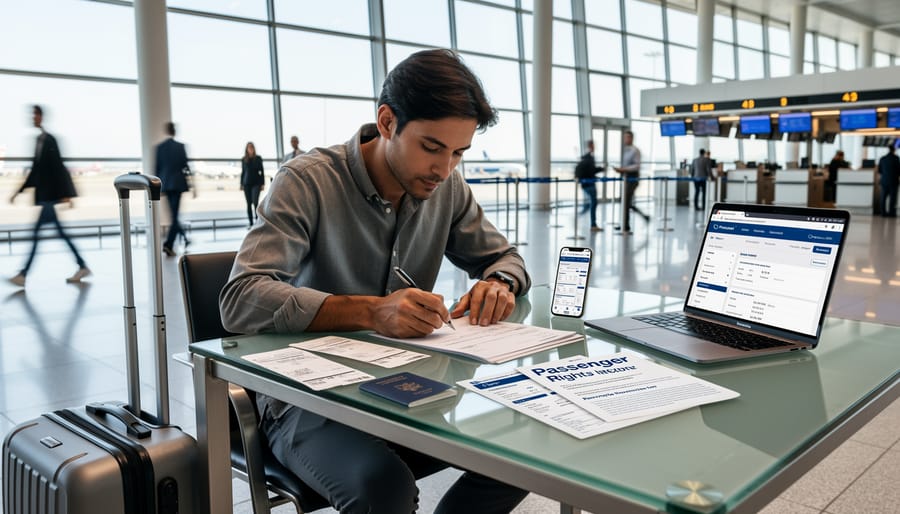
Good news: Air Canada’s actually made this part way less painful than it used to be. A few years back, claiming compensation meant filling out forms, mailing documents, and waiting months for a response. Now they’ve got a Self-Serve Eligibility Tool that does most of the heavy lifting for you.
I’ll be honest, I was skeptical the first time I tried it. But here’s how it works, and it’s genuinely straightforward:
- Head to Air Canada’s customer service portal and look for the “Flight Disruptions” section where you’ll find the Self-Serve Eligibility Tool.
- Enter your flight details including your booking reference number, flight number, and travel date. Have your confirmation email handy because you’ll need these specifics.
- Answer a few quick questions about what happened, like how long your delay was and where you were flying. The tool calculates whether your situation qualifies for compensation based on the APPR regulations we talked about earlier.
- If you’re eligible, the system will tell you how much you’re owed and walk you through submitting your claim right there. No extra forms, no mailing anything in.
Before you start, grab your boarding pass (a photo on your phone works), your booking confirmation, and any delay notifications Air Canada sent you. The process goes faster when you’ve got everything in one place.
One insider tip: if your flight was operated by Air Canada Express or Air Canada Rouge, make sure you’re still going through Air Canada’s main customer service portal. These partner flights are covered under the same compensation rules, but sometimes travelers assume they need to contact a different airline.
The whole thing usually takes about ten minutes if you’ve got your info ready. And unlike the old days of wondering if your claim disappeared into a black hole, you’ll get a confirmation number and updates on your claim status. It’s not perfect, but it’s miles better than the paper-and-pray approach we used to deal with.
My Top Tips for Getting Your Compensation Faster
I’ve learned a few things the hard way about getting compensation from airlines, and honestly, being organized from the start makes all the difference. Here’s what I wish someone had told me before my first claim.
First, treat your boarding pass like gold. I snap a photo of mine the second I get it and save it in a dedicated travel folder on my phone. Same goes for your baggage tags, gate change notifications, and any delay announcements on the departure board. When you’re sitting at the gate waiting three hours, take photos. It feels excessive until you need proof that Air Canada actually delayed your flight, not you.
Keep all your flight numbers handy. Sounds basic, but if you’re connecting through Toronto or Montreal, you’ll need every segment’s details when you file. Add your confirmation code to your Canada trip checklist before you even leave home.
When you check flight delays and realize you’re entitled to compensation, file your claim as soon as possible. Don’t wait weeks. The Self-Serve Tool is straightforward, but have your information ready so you’re not scrambling to remember details from a chaotic travel day.
One more thing: save any emails or text updates Air Canada sends about your delay. They’re timestamped proof of what happened and why. The airline has your flight data, sure, but having your own documentation speeds things up and prevents back-and-forth disputes about timing.
Bottom line? Document everything, stay organized, and don’t procrastinate on filing. Your future self will thank you when that compensation lands in your account.
Don’t Let a Delay Ruin Your Canadian Adventure
Look, flight delays are frustrating. There’s no sugarcoating that moment when you see “DELAYED” flash on the departure board. But here’s what I’ve learned from years of exploring this incredible country: knowing your rights transforms a travel headache into something far more manageable. You’re entitled to real compensation, 400 CAD for delays between three and six hours, and more for longer ones. That’s not pocket change; that’s a nice dinner in Quebec City or a guided hike in Banff covered.
The best Canada travel tips I can share? Be prepared, know what you’re owed, and don’t let airline hiccups steal your sense of adventure. File your claim, get your compensation, and get back to discovering everything this country offers. Safe travels!