
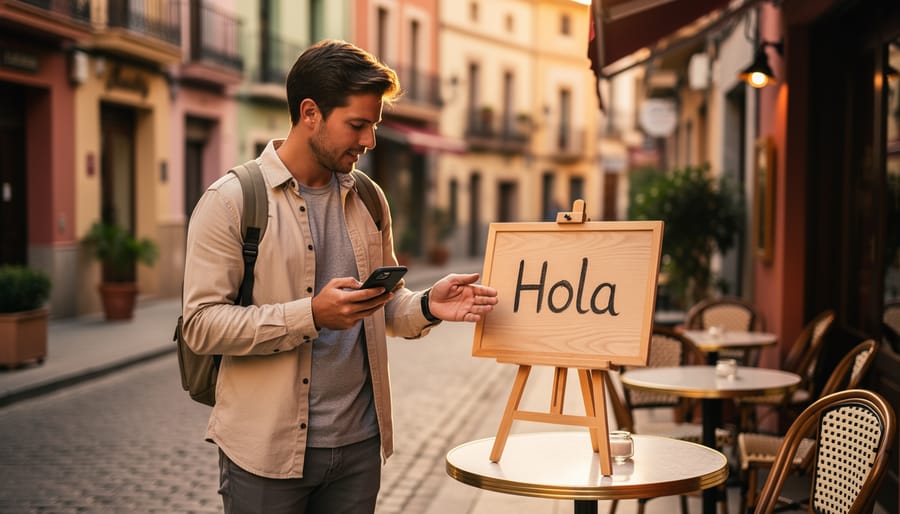
“Hola.” That’s the word you’re looking for. If you need to translate “hello” to Spanish, the answer is simple and universal across every Spanish-speaking country: “Hola” (pronounced OH-lah). Whether you’re a Canadian heading to Mexico for winter warmth, planning a South American adventure, or just trying to greet your new neighbors in Toronto’s vibrant multicultural community, this single word opens doors.
I learned the power of this greeting during my first solo trip from Vancouver to Barcelona. One “Hola” in a cramped tapas bar turned into an entire evening of broken-English-broken-Spanish conversation with locals who appreciated the effort. That’s the thing about learning even basic translations: they signal respect and curiosity, two qualities that travelers should pack alongside their passports.
But knowing “hello” is just the starting point. The real skill is learning how to translate on the fly when you’re standing in a bus station in Guatemala City or trying to order street tacos in Oaxaca. I’ve watched too many fellow Canadians fumble through their phones, hunting for the right app while a line forms behind them. You don’t have to be that person.
Today’s translation tools have become incredibly powerful and accessible. Google Translate can work offline if you download the Spanish language pack before you leave home (something I wish I’d known before losing cell service in rural Costa Rica). Apps like Spanish Translator + offer instant camera translation, turning printed menus and street signs into readable English. These aren’t just conveniences anymore. They’re essential travel tools, right up there with the Canada travel tips you’d study before exploring your own country.
What You’ll Need to Translate Hello (and Other Spanish Phrases)
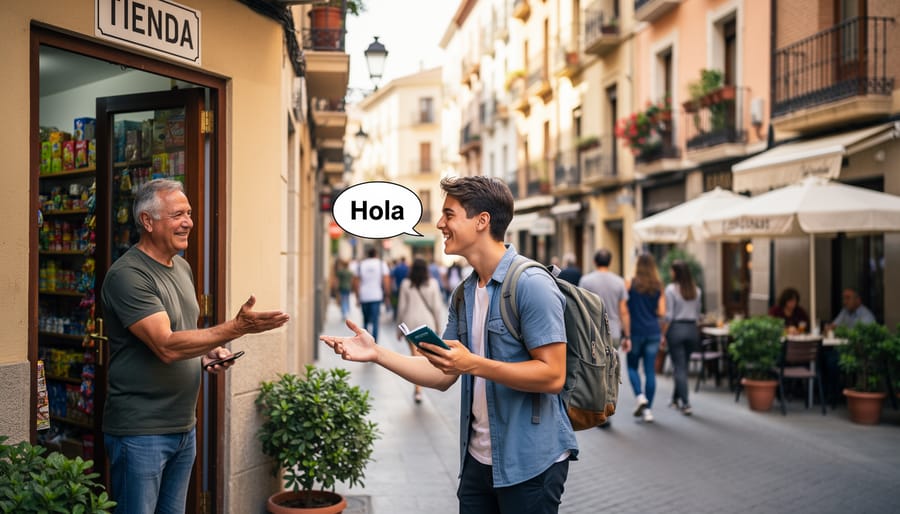
You don’t need much to translate basic Spanish phrases, but the right tools can make the difference between confidently ordering lunch in Mexico City and awkwardly pointing at a menu. I learned this the hard way during my first trip from Vancouver to Puerto Vallarta, when my phone died halfway through asking for directions.
The good news? Most translation tools are free and already on your phone. Google Translate is the heavyweight champion here, instantly translating between English and over 100 languages. It’s my go-to when I have a solid internet connection, especially for quick lookups or reading signs and menus with the camera feature. You can type, speak, or snap a photo of text, and it’ll give you the Spanish equivalent in seconds.
For travel without reliable data, the Spanish Translator + app deserves a spot on your home screen. It’s free with optional in-app purchases, but the real selling point is its offline translation features. Download the Spanish language pack before you leave home, and you can translate basic phrases even when you’re hiking in Oaxaca or exploring a pueblo with spotty service. I always grab the offline pack while I’m still connected to my Toronto Wi-Fi, usually the night before a flight.
Here’s what I keep in my translation toolkit, depending on the situation:
- Google Translate for everyday translations when you have internet (free, works on any device)
- Spanish Translator + app for offline use during travel (free with downloadable language packs)
- Canada’s Translation Bureau website for formal documents or official communications (free government resource)
- A pocket phrasebook as backup when batteries die (old school but reliable)
My insider tip? Download everything you need while you’re still at home or in a café with strong Wi-Fi. Cross the border prepared, not scrambling at the airport for a download that won’t complete. Trust me, your future self will thank you when you’re confidently greeting locals with a proper “Hola” instead of fumbling with a dead phone.
Before You Translate: Common Mistakes to Avoid
I’ll never forget the afternoon I stood in a Mexico City taxi, confidently telling the driver I was “embarazada” when I meant to say I was embarrassed about my poor directions. His confused smile and my friend’s stifled laughter taught me that translation apps don’t catch every nuance. The word actually means pregnant, and that moment became my crash course in why context matters more than a quick digital lookup.
The biggest trap with automated translation tools is treating them like perfect dictionaries. Google Translate and similar apps excel at single words like “hola,” but they stumble with context, tone, and regional variations. Spain’s casual greeting might differ from what you’d hear in Guatemala or Argentina, even when the base translation stays the same. Before your trip, download one of those offline features mentioned in your packing tips because relying on data connectivity south of the border can leave you speechless at the worst moments.
Another common mistake is skipping the formality check. “Hola” works for most casual situations, but formal settings might call for “buenos días” or a different greeting entirely depending on the time and context. I learned to cross-reference translations with at least two different tools before important conversations, especially when booking accommodations or asking for help. Save professional translation services for documents, business meetings, or medical situations where precision matters more than speed. For everyday travel greetings and basic phrases, your phone’s translation app handles the job, provided you’ve tested it beforehand and understand its limits.
How to Translate ‘Hello’ to Spanish: Step by Step
I remember the first time I needed to translate a simple word before my trip from Toronto to Cancun. Standing in my kitchen with my suitcase half-packed, I realized I didn’t actually know how to say “hello” in Spanish beyond what I’d heard in movies. That moment of panic led me to pull out my phone and figure out the translation process that I now use constantly when traveling.
The good news? Translating “hello” to Spanish takes less than a minute once you know the basic steps. Here’s exactly how to do it using the tools most travelers already have:
- Open your translation tool. Launch Google Translate on your phone or computer (it’s free and works with over 100 languages), open the Spanish Translator + app if you’ve downloaded it, or navigate to a browser-based translator. I keep Google Translate bookmarked on my phone’s home screen for quick access during trips.
- Set your languages. Select English as your source language in the left box and Spanish as your target language in the right box. Most tools remember your language pair after the first use, which saves time when you’re translating multiple phrases while packing or at the airport.
- Enter or speak “hello”. Type the word into the text box, or tap the microphone icon and say it out loud. The voice feature became my best friend when I was juggling luggage and trying to learn phrases on the plane. If you’re unsure about spelling a word, speaking it is way faster and catches fewer errors.
- Read your result: “Hola”. The translation appears instantly. That’s it, “hello” in Spanish is “Hola.” Most tools also include a speaker icon you can tap to hear the pronunciation, which helped me practice before landing in Mexico.
One insider tip I wish I’d known earlier: download the offline features in Google Translate or the Spanish Translator + app before you leave Canada. When I crossed into areas with spotty data during my Cancun trip, having offline translation saved me countless awkward moments at restaurants and shops.
The voice translation feature deserves special mention. When you’re standing at a market stall or checking into your hotel, pulling out your phone and speaking into it feels less intimidating than trying to type while someone waits. Just make sure you’re in a reasonably quiet space so the app picks up your words clearly. I’ve found it works best when I speak at a normal pace, not the slow, overly-enunciated voice we sometimes use with technology.
Understanding Your Translation: Context and Usage

Knowing “Hola” is just the starting point, the real magic happens when you understand when to use it and how it fits into the cultural fabric of Spanish-speaking communities. I learned this firsthand while chatting with Spanish-speaking vendors at Toronto’s Kensington Market before my trip to Costa Rica. They warmly corrected my timing mistakes, and those small lessons made a huge difference once I arrived.
“Hola” is your friendly, all-purpose greeting that works in most casual situations, think coffee shops, markets, or chatting with fellow travelers. It’s informal and warm, perfect for breaking the ice. But Spanish culture places importance on time-specific greetings. “Buenos días” (good morning) runs until roughly noon or early afternoon, “buenas tardes” (good afternoon/evening) carries you through until sunset, and “buenas noches” (good night) takes over afterward. These aren’t just formalities; they show you’re paying attention.
The formality question matters too. When addressing someone older, in a professional setting, or showing respect, you might pair your greeting with “señor,” “señora,” or “señorita.” In Spain, you’ll encounter “Buenos días” more formally than in Latin American countries, where warmth and casualness often dominate even initial meetings.
Here’s my insider tip for Canadians: practice these greetings in your own backyard first. Montreal’s Plateau neighborhood, Toronto’s Little Portugal, or Vancouver’s Commercial Drive all have thriving Spanish-speaking communities. Pop into a local restaurant or café and try out your “buenos días” with the staff. They’ll appreciate the effort, and you’ll build confidence before heading south. The muscle memory you develop ordering empanadas on Queen Street will serve you incredibly well when you’re navigating Mexico City or Barcelona.
Context shifts everything. “Hola” at a beach bar in Playa del Carmen? Perfect. “Buenos días, señora” when checking into your hotel in Madrid? Even better. Understanding these nuances transforms you from a tourist fumbling through phrases into a traveler making genuine connections.
Testing Your Translation and Next Steps
You’ve got your translation, but it’s smart to verify it before your trip takes you into real conversations. I learned this the hard way during a layover in Mexico City when I confidently used a phrase I’d quickly looked up, only to realize later it didn’t quite mean what I thought.
Cross-check your translation using two different tools. Try ‘hello’ in Google Translate, then verify it with the Spanish Translator + app. If both give you ‘Hola’, you’re golden. This double-check habit becomes essential when you move beyond basic greetings to more complex phrases where context matters.
If you’re in a Canadian city with a strong Spanish-speaking community, practice with native speakers. Coffee shops in Toronto’s Kensington Market or Montreal’s Latin Quarter offer friendly opportunities to test your greetings. Most people appreciate the effort and will gently correct you if needed.
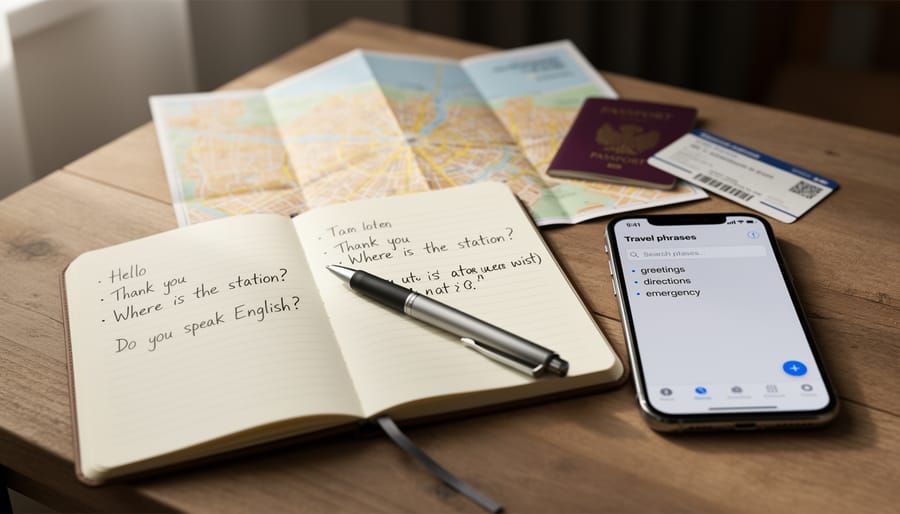
Now build your travel phrasebook. Start with the essentials beyond ‘Hola’: ‘Gracias’ (thank you), ‘Por favor’ (please), ‘Disculpe’ (excuse me), and ‘Dónde está’ (where is). I keep these in my phone’s notes app with a backup screenshot saved to photos, just in case my battery dies.
Download the Spanish Translator + app’s offline features before you leave Canadian soil. Hotel Wi-Fi abroad can be unreliable, and roaming charges add up fast. Having translations available without data saved me countless times in rural areas between Cancun and Tulum.
Create a custom list for your specific destination. Beach trips need different vocabulary than city tours or mountain hikes. I add location-specific terms like ‘playa’ (beach) or ‘sendero’ (trail) depending on where I’m headed.
Practice these phrases daily for a week before departure. Say them out loud while making coffee or during your commute. The muscle memory helps when you’re tired, jet-lagged, or nervous about speaking a new language.
Common Questions About Translating Hello to Spanish
Is ‘Hola’ used in all Spanish-speaking countries?
Yes, ‘Hola’ is universally understood and used across all Spanish-speaking countries, from Mexico to Argentina to Spain. While regional greetings exist, ‘Hola’ works everywhere and is your safest bet when traveling.
Can I use translation apps without internet?
Absolutely! The Spanish Translator + app includes offline translation features, which is a lifesaver when you’re exploring remote areas or trying to avoid roaming charges. Download the offline language pack before you leave home, it’s one of those money-saving tips that really pays off when you’re traveling.
What other basic greetings should I know beyond ‘Hola’?
Start with ‘Buenos días’ (good morning), ‘Buenas tardes’ (good afternoon), and ‘Buenas noches’ (good evening). These time-specific greetings show cultural awareness and often earn you warmer responses from locals.
When should I use formal versus informal greetings?
Use ‘Hola’ in most casual situations with peers, shopkeepers, and fellow travelers. For business settings, government offices, or when addressing older individuals, pair it with ‘Buenos días’ or the formal ‘usted’ form when continuing the conversation.
One question I hear constantly from fellow Canadians planning trips south is whether regional differences matter. While ‘Hola’ remains consistent, you might notice locals in Spain using ‘¿Qué tal?’ more frequently, while in Mexico ‘¿Cómo estás?’ is common among friends. Don’t stress about these variations, your friendly ‘Hola’ opens doors everywhere, and locals appreciate any effort to speak their language, even if your accent gives away that you’re from Calgary or Halifax.
Google Translate handles basic greetings flawlessly and works between English and over 100 other languages, making it perfect for quick reference checks. I keep it bookmarked on my phone alongside my boarding passes. For government-level accuracy, Canada’s Translation Bureau helps serve Canadians in both official languages plus foreign languages, though that’s more for formal documents than casual travel phrases. The key is starting with ‘Hola’ and building from there as your confidence grows.